
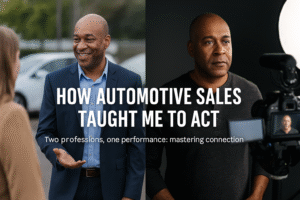
What Acting and Car Sales Have in Common
If you told me years ago that my time on a dealership floor would prepare me for performing on camera, I might’ve laughed and offered you a brochure for the latest model instead. But looking back now — after years in both worlds — I realize that selling cars and acting aren’t just distant cousins. They’re practically siblings. Both require emotional intelligence, storytelling, adaptability, and the ability to read people like a book that’s missing a few pages.
I didn’t plan for it to turn out this way. My paths just sort of merged, like two lanes on a well-paved highway (minus the occasional pothole of rejection). Whether I’m delivering a heartfelt commercial read or working with a shopper to help them find their perfect vehicle, I’m tapping into the same skill set — human connection.
Let’s pop the hood on how these two worlds overlap — and why, if you can sell a car, you might just have the chops to command a performance in front of a camera or behind a microphone.
Reading the Room Like a Pro
When you’ve spent years in automotive sales, you get pretty good at reading people — not in a psychic way, but in a “I can tell you’re not buying anything today, but I’ll still treat you like you are” way.
In sales, the first few seconds matter. You’re gauging posture, tone, word choice. Are they cautious? Confident? Curious? You learn to pick up micro-expressions — that flicker of excitement when they spot a car that speaks to them, or that subtle eye-roll when they realize the payment might not fit their budget. You adapt your approach in real time, like a jazz musician riffing off a melody you didn’t plan.
When I transitioned into acting, I realized: this is the same skill — just applied differently. Whether it’s walking into an audition or working on set, you’re reading the room, feeling the energy, and adjusting your performance to fit the moment.
A director might give you minimal direction but expect you to read between the lines. The casting assistant might smile politely, but you can tell whether they’re truly engaged. The audience — whether it’s one person or one million — senses authenticity, just like a customer does.
Both fields demand emotional intelligence. You’re not just selling a car or performing a script — you’re connecting. You’re trying to understand what someone wants to feel, and then helping them feel it.
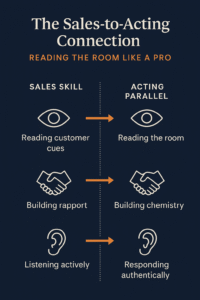
💡 Acting and sales both reward empathy — the ability to see the world through someone else’s eyes and respond in kind.
Here’s how I demonstrate the connection skill that drives my work. No Second Guessing.
External reading break: Harvard Business Review’s piece on “Emotional Intelligence Has 12 Elements. Which Do You Need to Work On?”
Storytelling Sells
At its core, every sale — and every performance — is a story.
In the showroom, I’m not talking about vehicle features. I’m painting a picture:
“Imagine hopping into your car and heading to work in the morning. You’re full of confidence because you know you’re driving a reliable vehicle that’ll take you to work with no problems.
That’s not a pitch — that’s a scene.
It’s the same thing I do behind the mic or in front of the camera. When I read a script, I’m not just delivering lines — I’m telling a story that resonates emotionally. Whether it’s a commercial for a family sedan or a heartfelt health insurance ad, I’m trying to make the listener see themselves in that world.
There’s a famous saying in both marketing and acting: “People don’t buy products — they buy feelings.”
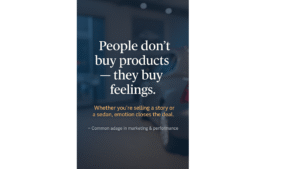
The same could be said for performances. Audiences don’t remember every word; they remember how you made them feel.
🎙️ Whether you’re selling a story or a sedan, emotion closes the deal.
And here’s the kicker: when your story feels genuine, it doesn’t feel like selling. It feels like sharing. The best car sale I ever made wasn’t because of the price or the vehicle features — it was because I told the right story, to the right person, at the right time.
Notice the tone in each of these mini-stories.
Here’s a little science for ya! The Science of Storytelling: How Neuromarketing Builds Emotional Loyalty (Forbes)
Improvisation Under Pressure
If there’s one skill every salesperson learns early, it’s how to think on your feet. Because let’s face it — no deal ever goes exactly as planned. You can have your perfect pitch ready, but once the customer asks, “Is there anything else less expensive?” or “Does it come in blue?” — the script goes out the window.
That’s where improvisation comes in.
When I trained in improv at Second City, I realized I’d been doing it for years without realizing it. Sales taught me to pivot. Improv just gave it structure and polish.
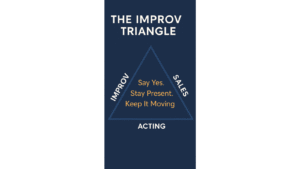
“Always say yes” in improv translates beautifully to “stay open” in sales — and in acting. You listen actively. You adapt. You stay present. Because the moment you check out, the connection dies.
And improv isn’t just about being funny — it’s about being alive in the moment. It’s about reacting honestly and keeping the scene (or conversation) moving forward.
Whether I’m auditioning for a spot or recording a corporate narration, the mindset’s the same: Don’t freeze. Flow.
⚡ Improv teaches resilience — the ability to keep creating even when things don’t go as planned.
Learn how to “Yes…And” here The Second City Training Center – Chicago
Lessons Learned
Here’s what years of switching gears between acting and sales have taught me:
- 👥 People buy from people they trust — and audiences believe actors who feel authentic.
- 🧠 Emotional intelligence is a superpower in both professions.
- 📝 Storytelling turns transactions into experiences. — None of us like to be sold, but we all love to buy.
- ⚡ Quick thinking creates memorable moments. — Be bold, make a choice and commit to it.
- 🌟 Authenticity always outperforms perfection. — Always be yourself.
Both industries are competitive, unpredictable, and occasionally exhausting — but the reward comes from connection. That moment when a car shopper says, “You really listened,” or when a director says, “That’s the take!” Same dopamine hit. Different stage.
Why This Connection Matters
For me, the overlap between acting and sales isn’t just philosophical — it’s practical. The confidence I gained from pitching cars helps me walk into auditions with poise. The empathy I honed in acting makes me a better communicator in business. Each discipline sharpened the other.
And honestly, I think that’s true for anyone switching careers or juggling multiple passions. Skills don’t exist in silos. They translate. They evolve. The trick is learning to see how.
If you’re someone straddling two seemingly different worlds — maybe corporate and creative — take heart. You’re not starting over. You’re cross-training.
So the next time you’re in a job that doesn’t feel connected to your dream, remember: every skill you learn might just be preparing you for your next act.
Your Turn
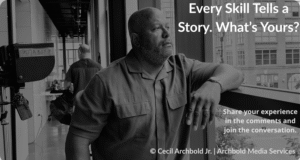
I’d love to hear from you — have you ever had a job that secretly trained you for something totally different later in life? Drop your story in the comments below!
And if you enjoyed this post, consider following the Cecil Sez Blog for more stories at the intersection of acting, entrepreneurship, and creativity.
Here, I’ll keep exploring what it really takes to build a career fueled by passion, purpose, and maybe a touch of caffeine.