AI voices are getting better.
Not “kind of better.” Not “better for robots.” Actually, noticeably better. The breaths land in mostly the right places. The pacing has some shape to it. If you’d played me some of these reads five years ago, I’d have guessed a human recorded them on a decent mic.
I’ve watched technology reshape the industries I’ve worked in. In printing, digital presses took over work that used to belong to conventional offset presses. In car sales, dealers now use AI chatbots to talk with customers before they ever set foot in the showroom. Voiceover was never going to be the exception.
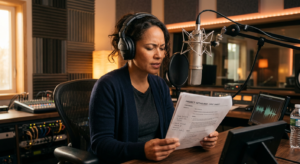
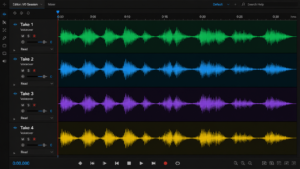
I’m a voice actor, so you might expect me to hedge on that. I’m not going to. I’ve run my own scripts through generative AI voice tools and listened back against my own reads, line by line. The technology is real, it’s improving fast, and pretending otherwise doesn’t help anybody. That includes the production companies and agencies I work with through Archbold Media Services.
Here’s where I land, though, and it’s probably not where you’d expect a voice actor to land.
I think this is good news.
It isn’t good news for every voice actor. It’s good news for the ones who bring more than a voice to the table. And if you’re on the buying side, it’s good news for you too. You’re about to have a much clearer picture of what you’re actually paying for.
Yes, AI Voices Are Getting Better. Let’s Just Say It.
Most of the conversation about generative AI in voice acting falls into one of two camps. One camp says AI is coming for every voice actor’s job by next Thursday. The other says AI will never sound human, so relax. Neither is very useful if you’re a producer with a deadline and a budget trying to make a real decision.
So here’s the straight version.
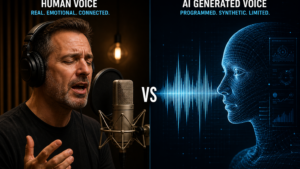
AI voice quality has improved dramatically, and it’s still improving. When WPP Media studied how people respond to AI voices in audio ads, fewer than half of participants could reliably tell which voices were synthetic. But here’s the detail I find more interesting: people still rated the ads higher when they believed a human was talking.
In other words, part of what people value in a human voice isn’t just the sound. It’s knowing a person is behind it. For producers, that’s worth factoring into the casting decision. For voice actors, it means “human” is an advantage, but only if the performance gives listeners something to believe in.
None of that means AI has no place in a production workflow. It does, and pretending otherwise would undercut everything I just said. For a growing list of jobs, it’s a legitimate option:
- Scratch tracks and animatics for client approval
- Internal training modules with a short shelf life
- High-volume content where the script changes weekly
- Rough cuts where the voice is a placeholder, not the product
If you’re using AI for those things, I’m not going to wag a finger at you. That’s a reasonable business decision. I’d probably make the same call in some of those situations.
What I’d push back on is the leap from “AI is good enough for some jobs” to “AI is good enough for the job.” Those are two different sentences, and the space between them is where this whole post lives.
Admitting AI is getting better isn’t surrender. It’s the starting point for an honest conversation about what a voice actor is actually for.
AI Isn’t Replacing the Top. It’s Replacing the Middle.
Here’s the part I don’t hear many people say out loud.
AI isn’t raising the ceiling of voice performance. It’s raising the floor. That shift doesn’t hit everyone equally.
The “Fine” Read Just Lost Its Value
Every producer knows the read I’m talking about. Clean audio, correct pronunciation, on time, and completely forgettable. Nothing wrong with it, nothing memorable about it. For years there was a steady market for that read because “fine” used to require a human, a booth, and a booking.
It doesn’t anymore. AI can deliver “fine” in minutes, for a fraction of the cost, with unlimited revisions.
So the voice actors who were selling “fine” are in real trouble. I’m not going to sugarcoat that, and I’m not writing about it from a safe distance. Some of that work has been mine, too. The middle tier of interchangeable, competent, nobody-will-remember-it voice work is getting squeezed, and it’s not coming back.
What I Learned From Making Beer in My Basement
I’m a home brewer, and this reminds me of something I’ve watched play out in beer.
Full disclosure: I don’t drink much of the mass-produced stuff. Some friends call me a beer snob. I prefer to say my palate is just a little more refined. They don’t buy that either.
But I’ll give the big brewers their due. Mass-produced beer is incredibly consistent. Same taste, every can, every city, every time. Nobody would call that a failure. It’s an engineering achievement. But consistency never made craft brewing irrelevant. If anything, it made the difference easier to taste. When the baseline is reliable and predictable, the thing that stands out is the thing somebody made a choice about.

Voice is heading the same direction. “Consistent and acceptable” is becoming the cheap default. And when that happens, what people are willing to pay for shifts to judgment, interpretation, and intention. That’s the stuff I wrote about in What AI Can’t Replicate About a Great Voice Performance (Yet).
AI is eliminating the forgettable middle, and the gap between commodity voice work and genuine performance is getting wider, not narrower.
Why a Higher Floor Is Good News (Including for the People Hiring)
If you’re a production company or an agency, you might be thinking: “Great for the top-tier voice actors. What does that do for me?”
Quite a bit, actually.
The Difference Gets Easier to Hear
When the baseline was a mixed bag of human reads, it was harder to tell whether you were getting real value. Now AI gives you a reference point. Put an AI read next to a human read on the same copy, and the gap between “says the words” and “means the words” becomes obvious. Your clients hear it too, and that makes it a lot easier to justify a human voice actor in the budget when the project calls for one.
Voice Actors Have to Earn the Rate
This is the part I actually like. A higher floor means voice actors can’t coast on simply being available. Fast turnaround and clean files used to be selling points. AI made them the bare minimum. What’s left for a human to earn the rate with is everything around the audio: smart questions, catching a problem in the script before recording, options you didn’t have to ask for, and taking direction without drama. I’ve written about what clients actually want from a voice actor, and almost none of it is about the sound of the voice. AI just turned that list from “nice to have” into “the whole reason to book a human.”
Casting Conversations Get Clearer
Instead of a fuzzy “do we have budget for talent?” conversation, you can have a sharper one: “Is this a job where the voice is the product, or just the delivery mechanism?” That question saves time, and it protects the work.
A higher floor doesn’t shrink the value of great voice acting. It makes that value easier to see and easier to justify.

A Practical Framework: When AI Is the Right Call (and When It Isn’t)
Philosophy is nice. Deadlines are real. So here’s the framework I’d use if I were sitting on your side of the table, deciding between AI and a voice actor for a given project.
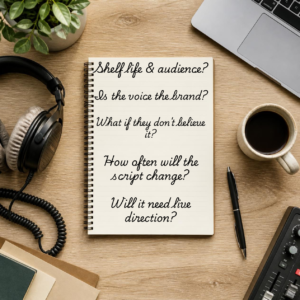
Ask these five questions.
1. How Long Will This Live, and How Many People Will Hear It?
A training module that gets replaced next quarter and heard by 40 employees? AI is probably fine. A national spot, a brand anthem, or an evergreen explainer heard by thousands? The voice is carrying a lot more weight. The longer the shelf life and the bigger the audience, the more the performance matters.
2. Is the Voice the Brand, or Just the Delivery Mechanism?
If the voice needs to be something (warm, trustworthy, confident, recognizable), you’re asking for identity, not just audio. Brands build vocal identity over years. That’s hard to build on a voice the client doesn’t own a relationship with.
3. What Happens If the Listener Doesn’t Believe It?
This is the big one. If a slightly flat read costs you nothing, AI is a reasonable bet. If a flat read costs you trust (in a car commercial, a healthcare message, a financial services spot, or onboarding that shapes someone’s first impression of a company), the stakes change completely.
That’s not just a voice actor’s hunch. In an Adobe Express survey of U.S. consumers, more than half said they’d trust a brand less if it used AI-generated voices in its ads. For an agency protecting a client’s reputation, that’s a number worth sitting with.
4. How Often Will the Script Change?
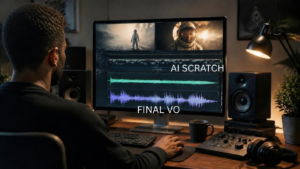
Be honest here, because this one cuts in AI’s favor. If the copy is going to churn daily, AI’s speed and endless revisions are a genuine advantage. Plenty of producers use a hybrid: AI for scratch and approval rounds, then a human voice actor for the final once the script locks. That’s smart workflow design, and I’m happy to step in at the end of that process.
5. Will This Need Real-Time Direction?
If you know the session will involve notes like “a touch more confident, but not cocky,” you need someone who can interpret that in the moment. Either way, clear direction helps. Whether you’re prompting an AI tool or briefing a human, writing better voiceover specs is the fastest way to get what you actually want.
The Quick Scorecard
- Leans AI: short shelf life, small or internal audience, voice is a placeholder, script changes constantly, low trust stakes
- Leans human: long shelf life, public audience, voice is the brand, trust or emotion is on the line, direction will matter
If most of your answers land in one column, you have your answer. If they’re split, use AI for drafts and a human for the final.
The right question isn’t “AI or human?” It’s “what is this voice responsible for?”
Where I Stand: From Inside the Tools, Not Outside Them
I want to be clear about where this perspective comes from.
I’m not a voice actor shouting at the AI wave from the beach. I completed a prompt engineering specialization through Vanderbilt, and I haven’t stopped there. I build courses that help people use AI tools in their businesses and personal lives, and I build tools that help me run my own business more efficiently and profitably. I’ve tested the voice tools on my own copy specifically so I could speak about them honestly instead of fearfully.
I’ll be honest about something else, too. Some of the work AI is absorbing has been part of my income. “Good news” doesn’t mean painless, and I’m not going to pretend I’m indifferent about it. What it does mean is that I’ve had to be deliberate about where I’m headed.
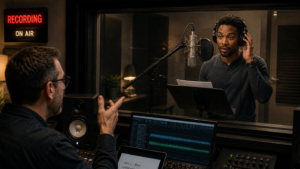
That looks like one-on-one coaching and group training with other voice actors. It looks like a weekly voiceover workout group where I read scripts myself and also direct other actors on their reads. Sitting in the director’s chair is some of the best training there is for understanding what a producer needs from a session. And it looks like building deeper skills in commercial work and medical narration (patient education, explainers, and pharmaceutical spots), where trust and human judgment carry the most weight.
For you, that means the human you’re hiring isn’t coasting. They’re investing in exactly the things AI can’t replicate yet.
That’s part of my creative journey, and it’s shaped how I see all of this. Sales taught me how people think. On-camera acting taught me how people feel. Voiceover taught me how people listen. Technology is teaching me how people learn, including how quickly they can tell when something’s missing, even if they can’t name it.
So when I say AI getting better is good news, I’m not putting on a brave face. A higher floor forces everyone in this business, me included, to be clear about what we offer. For me, that’s judgment, interpretation, reliability, and being easy to work with when the deadline gets tight.
If your project only needs the words said, use the tool. Seriously. If it needs the words to land, that’s the work I show up for.
I don’t compete with AI on speed or price. I compete on the thing it can’t do yet: make a choice that a real listener feels.

Let’s Keep the Conversation Going
I’m curious where you land on this. If you’re a producer or agency creative already using AI voices, what’s working, and where have you hit the wall? Drop a comment. I read every one.
If posts like this are useful, follow the Cecil Sez Blog for more honest takes on voice acting, generative AI, and the business of creative work.
And if you’ve got a project where the performance itself has to carry the weight (commercial, automotive, corporate narration, or eLearning), I’d love to be in the conversation. You can hear my demos at Cecil Archbold VO.